Wednesday, April 24, 2013

A Woman is a Woman (1961)


Angela is a burlesque dancer for a small club in Paris.  She and her lover Emile live a modest life in a small city apartment, in which they share moments of quiet domesticity and also melodramatic conflict.  Angela wants to have a child, but Emile isn't ready to make the commitment, and though she tries to persuade him he refuses to bend to her will.  They fight in overly dramatic fashion, breaking the fourth wall and bowing to the audience before commencing their fight, and pulling books from the shelves and using their titles to articulate their respective points.  Emile's best friend, Alfred, reveals that he is in love with Angela as well, something which Emile knows all too well already.  


Exasperated by Angela's pleas for a baby, Emile tells her to sleep with Alfred if she wants a child so badly.  Angela calls Emile's bluff and heads over to Alfred's apartment, in which we see her conflictingly undress as she mulls her decision.  Upon returning home, Angela finds Emile visibly upset yet still very much in love with her.  He comes to the realization that she will push their relationship to the brink in order to have this baby, and he decides that the only way to continue on is to make love to her so that the child would possibly be his.  Though they don't explicitly say whether or not Angela actually slept with Alfred, it is my belief that she did not and was simply using the threat as a gambit to force Emile's hand.


Jean-Luc Godard's "A Woman is a Woman" embodies everything that I've come to know about the dawning of the psychedelic era in France.  The young, bohemian lifestyle of the two lovers, the playfulness in which they act out the mundanities of young domestic life.  Godard really has fun with this picture, as he utilizes a grab bag of camera tricks and technical quirks in this cinematic world he creates.  Background noise is sometimes amplified to unrealistic levels or removed entirely from scenes, the impossibly gorgeous Angela (Anna Karina) breaks out in song in a scene that seems plucked from a musical.  The genre boundaries here aren't clearly defined, making for a completely unique film experience.  As previously mentioned, the two lovers break the fourth wall in order to address the audience, bowing for the performance of their quarrel before engaging in it.  Jump cuts are used as characters change outfits simply by walking through a door, and Angela flips an egg in the air and returns minutes later to catch it.  Non-diegetic music and dialog is inserted in certain portions of the film, creating a world in which the viewer feels anything is possible.  Godard even name checks his most popular film "Breathless" in one scene, with a character refusing to leave the house because the film is going to be shown on TV later.  This film is probably my favorite of Godard's simply for the fact that you can almost see him enjoying the filmmaking experience as you take it in, it's the cinematic equivalent of witnessing Jimi Hendrix in the throes of passion in the midst of a solo.  Godard is riffing here.


Jaws (1975)


What many refer to as one of the most perfect examples of effective filmmaking, Steven Spielberg's "Jaws" brought the quintessential monster movie to mainstream audiences.  In the quiet New England town of Amity Island, a teenage girl goes missing from a party and her mangled remains are later found washed ashore.  Though a marine biologist, Hooper, determines the cause of death to be from a shark attack, the mayor of the town refuses to close the beaches in fear of hurting the tourism industry, which the town so dearly relies on.  After a young boy is killed by a shark, the town begins searching for this unseen beast in an attempt to stop the killings.  


After a shark believed to be the killer is caught and later discovered not to be the one, Hooper and the benevolent police chief Brody set out to track and capture the true killer shark with the help of salty shark hunter, Quint, whose deep hatred for sharks is rooted in his own narrow escape from one during a shipwreck.  Ultimately, Quint's mad desire to kill the shark paralyzes their boat, leaving them stranded and vulnerable to the aquatic murderer.  The beast leaps onto the boat, sending Quint into its gnashing JAWS, as Brody seeks to save his own life atop the now sinking ship.  After successfully placing a scuba tank in the shark's JAWS, Brody exhibits his excellent marksmanship in shooting the tank with a rifle, exploding the shark into thousands of pieces and especially damaging the shark's JAWS.


Though it wasn't his original intention, Spielberg's decision not to showcase the actual shark served to only make the beast more frightening.  From even quiet scenes of an eerily undulating buoy, Spielberg is able to cull pure terror from an unseen villain, exemplifying the classic story structure of Man versus The Unknown, the sleepy American town undone by a mysterious and inhuman killer.  John Williams' iconic score adds to the uneasiness of the film, the now well-known two note phrase has become part of cinema legend, and can inspire fear even divorced from the image itself.  Spielberg's employing of water-level filming helps the audience experience the sensation of being in the water with the lurking shark, and his notable use of the Vertigo "dolly in, zoom out" technique shows a director unafraid to push his audience into unease and feel the terror that the film's characters are experiencing.  This being his first feature film, "Jaws" catapulted Spielberg into the upper echelon of successful filmmakers, and was a sign of future greatest to come.

Se7en (1995)


David Fincher's dark, serial killer classic "Seven" set a new bar for big market thrillers.  As crime scene detective David Mills (Brad Pitt) begins his new assignment alongside aging detective William Somerset (Morgan Freeman), a series of murders begins to plague the decrepit and rainy metropolis in which they live.  After discovering the words "Gluttony" and "Greed" written close to their respective murder victims, the two detectives come to discover that a killer is attempting to complete a series of murders mirroring the Seven Deadly Sins.  


After a couple close calls and some obstacles in the form of bureaucratic red tape involved in competent police work, the detectives begin to close in on their serial killer, just as he decides to turn himself in - covered in blood - at the police station.  Having witnessed the intricacy and meticulousness invested in his previous murders, the detectives find it highly suspicious that their chief suspect "John Doe" (who's gone through the trouble of cutting off his fingerprints for years) would simply turn himself in when he's only completed 5 of the 7 deadly sins.  Threatening to plead insanity if they don't comply, Detectives Mills and Somerset are lead by a shackled John Doe out into the lonesome desert, where they are met with a mail delivery of Mills' wife's severed head.  Repeatedly stating that he envies Detective Mills, the knowledge of his wife's death ultimately incites Mills to shoot and kill the murderer, completing the series of deadly sins.


In a stroke of genius, director David Fincher creates a bleak, unnamed city in which buildings have fallen into disrepair and rain falls constantly.  This choice not to attribute the film's story to any one city or time in history helps it stand the test of time, and creates the idea that this type of terror could descend upon any city, at any time.  The color palette of the film is extremely muted, with bright splashes of color only existing in the darkened basements of underground sex clubs and the photographic dark room of the killer himself… and the blood, which isn't so gratuitously splayed, but is portioned out in sudden and intense punctuation of the film.  One of the greatest differences between this film and other serial killer movies of its kind is that we actually come face to face with the murderer throughout the story.  From early chase scenes in which the killer's identity is obscured through clever backlighting and distant shots, to his surrender and revelation of intent, we see but we can't possibly comprehend this man.  Fincher's brilliant use of color and low angle photography help to drive the horror of this film, which many consider his breakthrough and establishment of himself as a burgeoning directorial talent.

L'Atalante (1934)


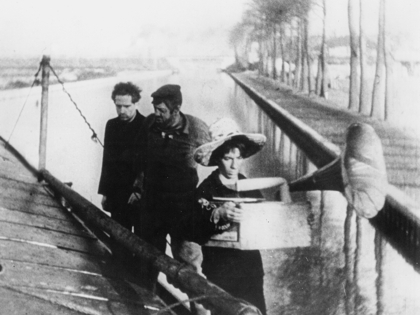
Jean Vigo’s “L’Atalante” tells a simple, yet timeless story.  It’s a story of a newly married couple learning everything about one other through sudden cohabitation… on a cargo barge.  The story begins as the wedding party procession marches through the small French town of the bride, Juliet, and makes it way to the waiting boat and it’s peculiar crew.  Jean, the captain of L’Atalante, brings his wife on board and completely immerses her in the glorified life of a sailor.  With his strange and worldly first mate Père Jules and their young cabin boy, the four journey to Paris as Juliet becomes accustomed to life on a barge, and the men deal with having a female presence on the ship.  Though Jean fills the beautifully impressionable head of Juliet with dreams and promises of exploring Paris together, when he is finally able to take his wife out on the town, he becomes seized with jealousy and ultimately leaves her stranded in a foreign city much more metropolitan than her home village.  While Juliet overcomes her naivety and learns to survive in the big city, Jean is gripped by loneliness and despair as he dreams of Juliet.  After some time apart, a chance meeting finds the two lovers reunited, and Juliet happily returns to L’Atalante with Jean.


“L’Atalante” employs a method of story exposition that was highly unusual for 1934, as we are first presented with the wedding procession passing through village streets while a bearded and his young assistant run ahead in an attempt to make a presentation of sorts.  Not until the bride and groom take their place upon the ship and wave goodbye to family and friends do we come to understand the trajectory of the story and its main characters.  It’s an interesting way to tell a perhaps common story, and it’s one of the reasons that Vigo’s filmmaking is endeared by so many.  Vigo incorporates bits of slapstick humor into his romantic drama, and the use of (at that time) groundbreaking camera techniques - such as superimposing two images over one another as Jean dreams of seeing his wife’s face underwater - proves that he was extremely progressive in his direction.  Vigo’s playfulness in telling an otherwise serious story is evident in its influence of modern day filmmakers such as Michel Gondry and Wes Anderson.