
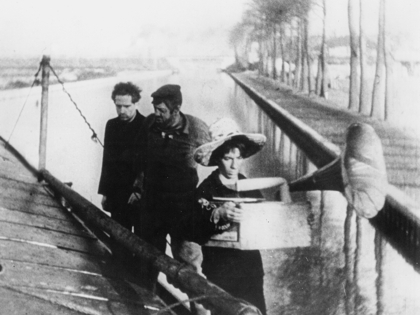
Jean Vigo’s “L’Atalante” tells a simple, yet timeless story. It’s a story of a newly married couple learning everything about one other through sudden cohabitation… on a cargo barge. The story begins as the wedding party procession marches through the small French town of the bride, Juliet, and makes it way to the waiting boat and it’s peculiar crew. Jean, the captain of L’Atalante, brings his wife on board and completely immerses her in the glorified life of a sailor. With his strange and worldly first mate Père Jules and their young cabin boy, the four journey to Paris as Juliet becomes accustomed to life on a barge, and the men deal with having a female presence on the ship. Though Jean fills the beautifully impressionable head of Juliet with dreams and promises of exploring Paris together, when he is finally able to take his wife out on the town, he becomes seized with jealousy and ultimately leaves her stranded in a foreign city much more metropolitan than her home village. While Juliet overcomes her naivety and learns to survive in the big city, Jean is gripped by loneliness and despair as he dreams of Juliet. After some time apart, a chance meeting finds the two lovers reunited, and Juliet happily returns to L’Atalante with Jean.


“L’Atalante” employs a method of story exposition that was highly unusual for 1934, as we are first presented with the wedding procession passing through village streets while a bearded and his young assistant run ahead in an attempt to make a presentation of sorts. Not until the bride and groom take their place upon the ship and wave goodbye to family and friends do we come to understand the trajectory of the story and its main characters. It’s an interesting way to tell a perhaps common story, and it’s one of the reasons that Vigo’s filmmaking is endeared by so many. Vigo incorporates bits of slapstick humor into his romantic drama, and the use of (at that time) groundbreaking camera techniques - such as superimposing two images over one another as Jean dreams of seeing his wife’s face underwater - proves that he was extremely progressive in his direction. Vigo’s playfulness in telling an otherwise serious story is evident in its influence of modern day filmmakers such as Michel Gondry and Wes Anderson.


No comments:
Post a Comment